
What are the problems that need to be tackled?
Despite an increased global awareness we seem to be lacking the means to deal with the problems we are faced with in the world today. This is despite the remarkable advances in international law and international institutions that have been made during the last decades. National sovereignty and narrowly-calculated state interest have remained the predominant norms governing international law and international institutions, leaving little room for international problem-solving and law enforcement.
Take as an example the question of environmental problems. Despite the increasingly acute situation and an overwhelming awareness, progress has been hampered by short-term industrial-benefit calculations, as could be seen by the US rejection of the Kyoto Protocol, for example. Without the world’s largest carbon dioxide emissioner as a party to the agreement, its goal to tackle the threats of global warming becomes severely weakened and so do the motivations of other states to participate, feeling they will have a disadvantage relative to the non-parties to the agreement.
Due to the preference given to national sovereignty rather than to personal sovereignty, also the international community’s ability to tackle international and domestic conflicts remains weak, with severe humanitarian suffering as a consequence. One might only look at Rwanda for one horrific example. Intervention remains subject to the will of the parties in the conflict or the interest of the permanent Security Council members. At the same time, intervention outside of the framework of international law has become more common, escalating the use of force and again weakening the faith in the global structure. The question of poverty, the other main factor behind worldwide humanitarian suffering, remains unsolved, with diverging results in the international institutions’ actions, developed countries’ trade, development policies and globalization. Also, and often as a result of these examples of international failures, terrorism has increased in scale and impact. At the same time, State responses to this threat sometimes highlight the disregard of an international standard of human rights to be followed by state actors. This safeguard of human rights and personal sovereignty as opposed to national sovereignty is also highlighted by the continuous abuse of human rights by states such as Iraq, China or Russia.
Europe as a contributor
Europe’s biggest contribution to tackling the above problems and to participating in the building of a sustainable world order for the 21st century is something it has been doing for the last half of the century without any particular idealistic ambition: it consists in slowly constructing an unprecedented example of supranational integration, where states give up certain aspects of their sovereignty in order to gain the benefits of supranational action in issues ranging from environment to trade policy. It also provides an example of a successful supranational institution-building, which despite its black holes has come close to a supranational democratic system, where states at large trust the institutional setup, to the extent that they have at large given up their veto powers.
Having supported such a liberal institutionalism within its own territory, it would be nothing but contradictory for Europe to reject supranational solutions at the world level, wherever needed. Rather, building on its own experience, Europe must make a loud voice for the advancement of international law, the establishment of successful international institutions and norms and the promoting of peaceful means of international co-existence. As a consequence, Europe must also promote the idea of multilateralism.
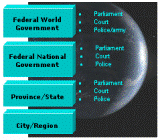
To take such a leading role in this development is not only necessary as a logical deduction from Europe’s own structure; it is a moral responsibility towards the actors around the world looking at Europe for leadership. Few world actors can provide a counterweight to US unilateralism, making change possible, and few can by their action give such a large political legitimacy to international development. Not only does a concern for the rest of the world make an active involvement necessary, but so also does a concern for Europe itself. What is the security impact in Europe by the US unilateral military actions that as a result increase the magnitude of rearmament and terrorism around the world? How is Europe affected by global warming caused both within its own borders and by its trading partners, not to mention the ozone layer? What are the effects in Europe of conflicts leading to humanitarian suffering, economic degradation, immigration etc? How does the hindrance to development in the developing world affect Europe through world instability, market failures, immigration etc.?
Europe and international law
International law has developed immensely over the past decade, not only in scope, but more importantly in legitimacy among states and citizens across the world. But expectations around the world have often been transformed into disappointment, as international law has failed and the UN has been unable to act. Or as nations bypass the UN in the international arena and choose to act on a unilateral basis, disregarding the progress made over the last decades in constructing a sustainable international regime.
Europe has often been a promoter of multilateralism, international law and UN legitimacy. But Europe must make these demands stronger. In a time where the US has again and again shown its disrespect of international law, bypassed the UN, and acted on a unilateral basis, often with military means, the world is looking to Europe for clear leadership. In cases like the Iraqi war, Europe must make its citizens’ voice heard throughout the world and condemn any unilateral action outside the UN. When pressure is being put on countries, for example, by the US to neglect the International Criminal Court, Europe must provide a counter pressure and moral support and participation.
But the UN and the international law system do not only need support, it also needs change. The Security Council, once constructed to picture the balance of power of that time, has become outdated, but as so often, a conservative institutional setup is preventing progress. Europe clearly needs to take its responsibility by promoting a far-reaching UN reform programme. Through a transformation of the Security Council setup, including the abandoning of veto among the permanent members, and the introduction of a democratic chamber within the UN, progress can indeed be made in international law, and also the UN as an institution can win back its legitimacy. The EU can start such a change by letting itself be represented by a single seat, but actions by, for example, Germany demanding a seat, or France and the UK holding on to theirs, do not exactly encourage such a development. Europe could also set an example by establishing its own army - an army that stands under an international control rather than under national command. This army should be left at the disposal of the UN as a permanent armed force to be used under a UN mandate, again increasing the UN ability to act and its legitimacy.
Remove double standards
Europe has become the world’s largest aid donor, again setting a good example for the world actors by its own actions. But aid is only one part of a development policy. During the last decades we have seen that the international community often used the developing countries to pursue its own economic or ideological goals. Europe must make a clear statement that the developing countries’ ability to develop themselves is not to be compromised about.
When it comes to trade, Europe has clearly shown by its unprecedented example of free trade within the EU that free trade between states is of benefit to all. With this background, it should be unacceptable for Europe to set double standards, keeping Europe’s external borders closed. Europe, that today forms the world’s biggest market, must live up to its own example and allow developing countries to access its markets, enabling them to pursue a sustainable development. In the Doha round, Europe’s message must be clear: no double standards between the developed and the developing countries! The Common Agricultural Policy is another issue that has to be forcefully tackled, for Europe to meet its responsibilities in the world. Here, again, it becomes clear that reform is not only a question of helping others, but that removing the borders is necessary for Europe to become more efficient and meet the competition challenges of this century.
The question of trade exemplifies the danger that Europe, built on the principle of supranational co-existence, may turn back to the outdated principle of a narrowly-calculated national egoism - but focused on the EU as a whole rather than on the individual member states. The EU as a supranational regime has developed internally after a vision based on certain values and strict efficiency calculation. If this calculation the EU is based on is true, then Europe can not legitimately give another equation as the solution to international questions involving other parts of the world. If Europe believes in non-militaristic conflict solution methods, it must not, for protecting European trade interests, lift an arms embargo against China. If Europe believes in the fundamental human rights and democratic society, European leaders should not, for whatever State/European energy interest, stand posing smiling on photos, arms round Putin. Rather, Europe should make a precedent, putting national - or European - self-interests aside and make a clear stance for global justice. Few are in a position to make a claim with such strength. Few with such strength to make this claim are willing to do it.
Changes within the EU needed to play such a role
...to play an active role in world politics Europe needs to speak with one voice...
As the world’s biggest market, and as a power with a large political legitimacy throughout the world, Europe is in a unique position to shape the world order, and world ethics, for this century. We have already seen the trust and hopes given to Europe by world actors searching for an alternative to US dominance. We have also seen that the EU - when speaking with one voice- has been able to push through steps in the right direction already.
But in order to play this role Europe must develop further, and member states must be brave enough to move forward; for the sake of national interest, for the sake of European interest, but also for the sake of meeting its responsibilities in the world.
A precondition for achieving the above is to create an institutional framework that allows Europe to speak with one voice at the world stage. To carry on this foreign policy must be a competence at the European level, where decisions are taken without the right of veto. To play an active role in world politics, Europe must be able to speak with one voice with a foreign minister. Speaking with one voice, Europe will have an impact, something none of its member states at present has in its own right.
Europe can make a difference for the world of tomorrow if it chooses to. Europe is ready. Are the national governments?



1. On 1 August 2006 at 11:07, by daniel schut Replying to: How can Europe Meet its Responsibilities in the World?
I think within Europe the main problem is France. The French government sees the EU as an ideal means to get more money, funding and geopolitical clout in the world, and it manipulates the EU into giving just that by using high-aiming, idealistic vocabulary. People are first tricked into believing it, then realize their wallets are drained, are unable to localize the culprit, and thus loose their confidence in the European Ideal. The EU would gain legitimacy around the member states if it would be less French.
2. On 1 August 2006 at 21:05, by Chris Replying to: How can Europe Meet its Responsibilities in the World?
This article begins by being very critical of nation states and national sovereignty. The national is bad, whilst presumably the supranational is good. But then it ends by saying that we need an EU, with a single voice in world affairs, in order to counterbalance the United States. The supranational here seems just like a slightly bigger version of the national. Why would this be such an improvement? Why would the EU, if it had just one voice, use it to such great effect? Do we have so much faith in Javier Solana and his team of Brussels civil servants? In these kind of discussions about the EU in world politics, it always seems that the jump beyond the ’merely national’ opens up a whole field of wonderful possibilities for ethical foreign policies. This strikes me as a little naive: our disillusion with nation states is simply recast in terms of enthusiasm for the supranational. Are the world’s problems really attributable to the existence of nation states?
3. On 2 August 2006 at 14:28, by Valéry-Xavier Replying to: How can Europe Meet its Responsibilities in the World?
Yes.
The Nation-State ideology states that the human race is bound almost “naturally” to be a permanent set of dividing lines within mankind.
The Nation-State however is merely a period of time in history : it has not been invented for a long time and may as well disappear for other forms of political organisations.
Its foundation is linked to the disappearance of traditionnal monarchies : where the king was the unifing factor, a post-monarchy state was to find a bound between individual, hence the invention of the concept of nation and the idea of the Nation State : it is the ideology that claims that citizens have a strong link between them and their State. This link was artificial and theoretical at first, the governements made it real though education, propaganda and war. It is now a political realtity as most citizens in many states actually refer themselves to it but it is in deep crisis as it is not appropriate for the global environment we live in : too small or too big, the Nation State has no longer either the monopoly of global action as private companies, NGOs and even private citizens are now also able to have a global action.
And the global world needs rules. A post-national democracy must allow decisions to be taken at an higher level and a democratic process to be developped beyons the national boudaries. The European Union is the most advanced experimentation on that field.
This new kind of political environment requires first that the faith in the old political model should weaken. This means also the faith in the values it stands for : ie national interest and Raison d’Etat. Postnational politics mean committing a new political approach and that is also valid for international relations as a whole.
In addition, policies in a post-national political organisation can only be led by common purpose to be defined in advance : as such, the darker motives of politics can less easily be made in to policies.
This hence does not make the idea of postnational politics naive : what you could say is merely that it is optimistic. This optimism is about the chance of such a new era to take place in a close future. We are in the midst of an extended transition period and in the midst of a crisis of the old model. The best is never a sure outcome. But pessimism leads to inaction and conservatism. Optimism leads to action and progress.
4. On 2 August 2006 at 15:15, by Valéry-Xavier Replying to: How can Europe Meet its Responsibilities in the World?
The French government is a part of the problem and has been for a long time but definitely not in the ways you mention that are extremely far-fetched.
It is a problem because the present French political Elite, like in Britain, are convinced that their country embodies everything that’s great in this world. They share a centralised national-state political and diplomatic culture and fail to see that the world has evolved around them.
Europe needs to be European : it is a new political process that cannot be influenced by a single national political culture - not French - nor British - nor German... and this is why it has such a great potential as we can build upon past experience - the goos and the bad - a better post-national democracy.
5. On 7 August 2006 at 12:50, by Chris Replying to: How can Europe Meet its Responsibilities in the World?
The concept of the nation was not invented simply as a way of filling in the vacum left by the fallen European monarchs. Take the French revolution. The monarchy was overthrown by popular mobilisation and action. We then saw a long battle over what name to give this popular force. Robespierre and the Jacobins refused the concept of the nation, and wanted only to speak of the people. Sieyes felt it was safer to have the nation as the people’s representative, and to build ’national’ institutions. The nation emerged as the name we have given to popular will. My problem with postnational politics is that we are trying to create political communities without any popular will as our starting point. Do we have a European people that can fill the vessel of a postnational European political system? We don’t. Do we see the European people out in the streets demanding the creation of European institutions? We do not. Until that happens, notions of postnational politics merely pushes us closer towards supranational rules and regulations, disconnected from people. It is a move away from the democratic forms that exist, in however limited a form, at the national level. Rather than a false optimism, I would prefer Gramsci’s invocation of “pessimism of the intellect, optimism of the will”.
6. On 14 September 2006 at 00:36, by Valéry Replying to: How can Europe Meet its Responsibilities in the World?
The French Revolution was born out of a few parisian riots that were used by the members of the Etats Généraux to take power. The idea that there was a popular will to support the whole process is a myth. There was merely a popular discontent with the economical situation.
The “national” ideology was used to pretend that the whole population of the kingdom had something gathering it. A lie and a myth to maintain the state as those populations were ruled by the same monarch as a series of historical incidents. It took another century of “national” ideology and state repression of minorities to obtain a kind of “national” homogeneity in the country. There never ever were people in the street asking for French national institutions, only people asking the king for more bread.
If you uncover the myth you discover the fact that the State is merely an institution aimed at providing serrvices to a population. It is no different from a city council, only bigger. Why not then organize larger institutions for larger issues ?
We have global problems that call for global solutions. the laternative is between having those solutions being dealt with through traditional undemocratic diplomatic means - or through a new international democracy.
It there is a rule of law at the international level - and they are greatly needed - then I want to be able to vote on them through an international democratic process.
About your “Do we see the European people out in the streets demanding the creation of European institutions?” : yes we do. This happens everytime federalist organisations gather at a European summit.
Follow the comments: |
|
