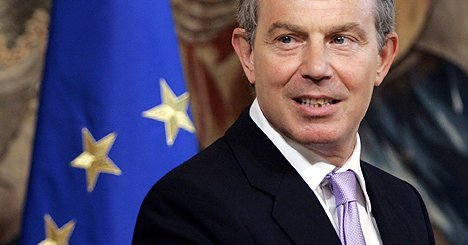
If the Lisbon Treaty is ratified by the Irish next October, two new important posts will be created: the Presidency of the European Council, and a High Representative for foreign policy. The person holding the Presidency of the Council would certainly be in a powerful position and would be the ideal figure to lead the Union towards new heights in international affairs. However, much depends on the member states because the President would be as powerful as they allow him to be.
The EU Council drives European agenda and takes critical decisions and that’s why it’s crucial to appoint an influential political heavyweight at its head. Former British PM and the current Middle-East envoy for the US, Russia, EU and UN; Tony Blair, was named as a possible candidate.
The member states must act as a united front if they wish to promote their stature abroad, and the best way of doing this is by having a strong leadership.
Blair would in fact be the ideal person for this post if the EU member states are hoping that the EU’s profile is raised internationally. His international experience and charisma certainly puts him above other candidates like the Luxemburg PM Jean Claude Juncker.
The Europe Minister, Lady Kinnock said, ‘Tony Blair is our man for EU President.’ The British Government has already formally declared its support for Blair’s candidacy even though Blair himself has not officially confirmed that he will be contesting.
This does not mean that the former British PM does not have opposition. Although a leftist, ironically enough, much of the disapproval to Blair’s candidacy comes from the socialists. Political rightists like former French President Giscard d’Estaing are also affirmed rivals. The Tories under Cameron have made it clear that Blair ‘should be let nowhere near the job’. There even exists a ‘Stop Blair’ online petition gathering signatures against his nomination. The reasons for such an opposition is Blair’s past record for supporting the US-led war in Iraq and also because he refused to endorse the single currency for his country.
Angela Merkel might also be reluctant to support Blair, mainly because his presidency could weaken her party and strengthen the socialists in Germany. Sarkozy’s public support for Blair’s presidency has also cooled; with the French President perhaps seeking to improve Franco-Spanish relations by considering supporting the former Spanish PM Felipe Gonzalez.
It’s difficult to decide what to do in such situations. Small and medium countries like Sweden may not be keen on a strong President, preferring a ‘council chairman’ instead. But would the EU ever make its voice heard if it continues on its road of division when it comes to leadership? The member states must act as a united front if they wish to promote their stature abroad, and the best way of doing this is by having a strong leadership.



1. On 12 September 2009 at 08:56, by Peter Replying to: Why should the EU Council have a strong leader?
Dear Luca,
you ask some valid questions, especially on the role of this potential new EU post and potential names. What is missing from your article, however, is a federalist perspective we discussed during the Convention on the future of the EU back in 2002/03 while still hoping for a Constitution, namely that we already have an EU post - the EU Commission President - that should speak on behalf of Europe, especially after some desired reform as invisaged by JEF would take place: further strengthening of the European Parliament, transforming the current EP into lower chamber and the current Council of EU into an upper chamber of a Parliament that elects a Commission President reflecting the results of the EP elections and/or taking into account coalition building. What we need in the EU are clearer, more transparent and more democratic processes and no longer nominations from the side of member states making the Union ineffective every time a MS no matter how big or small wants to push through its own national interests. We need strong and accountable institutions not persons!
2. On 12 September 2009 at 11:31, by Luca Replying to: Why should the EU Council have a strong leader?
Dear Peter,
The ideal thing is as you say strong institutions. However, we have to be realistic: the eu commission president has never been so effective in foreign policy. Europe is losing its grip in the international arena, and this is because it does not have strong leadership. America is strong because it has a strong president; China is strong because it has its own strong leader, the same goes with Russia. Leadership is important no matter as it is the leader who has to meet other foreign leaders in the name of the EU. And at this point in time there is no one better capable to do that than Blair himself.
3. On 12 September 2009 at 21:33, by Peter Matjašič Replying to: Why should the EU Council have a strong leader?
I agree with you that we need strong leadership in the EU but it shouldn’t and won’t ever come from the current system of governance. And the mere fact of having a new EU president post next to the existing Commission president post is for the Member States to further weaken the already week (current) Commission President. But if speak realistically as you say then it’s more important to elect a strong Commission president and leave the post of the Council Chair (because that’s what it is rather than proper President) to a person who will have the authority to bring the positions and interests of member states together and hopefully in favour of more Europe. Personally I don’t think Blair should be that person.
4. On 14 September 2009 at 14:25, by Manu Replying to: Why should the EU Council have a strong leader?
I totally agree with Peter’s concerns: this article woul fit nicely in Euroobserver, but where’s the federalist input?
Follow the comments: |
|
