Success: a genuine and worthy debate with conflicting ideas
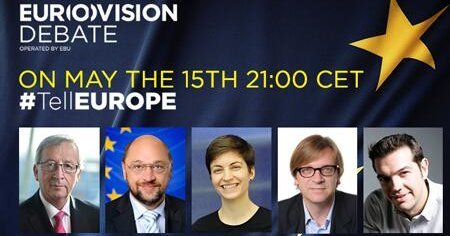
By many standards, this second European debate was a success. Alexis Tsipras, candidate for the European Left Party, was present, unlike for the previous debate, which introduced more controversy and widened the political spectrum. The 5 candidates expressed their ideas in a detailed, articulate and enthusiastic way (particularly fro Guy Verhofstadt), in the clear politicised fashion that you would expect from a mature democracy. In addition, candidates had more time to structure their answers this time (one minute, against 30 seconds in the first debate), which allowed for much more substance – that was one of the criticisms of the first debate. Furthermore, the themes covered were much more numerous than last time: youth unemployment, austerity, banking regulation, benefits of EU membership, Ukraine crisis, Catalonia and Scotland separatisms, immigration, religious symbols, low turnout to European elections, corruption and lobbyists, unofficial EC candidates, and the “why should Europe vote for you?” question. Finally, there were more than 63,000 tweets during the debate, which is much more than the first one (around 40,000).
…But was this really what we wanted?
Despite all the above-mentioned aspects, one can wonder whether this debate actually missed a point, which the first debate captured well. Language, to start with: the standard European citizen can reasonably be expected to speak and understand a bit of English, but not English, French and Greek. Those who watched the debate on Euronews surely felt lucky that they suddenly had an opportunity to improve their Greek and French language skills, but perhaps this is not really what they were after. It is fair to let candidates speak in the language of their choice, but it can leave voters with a blunt feeling of misunderstanding and distance, which is exactly the opposite of the purpose of the debate.
Second, this debate was much less interactive than the first one, which is a pity. Why force candidates to answer questions to a journalist when in reality we want to see them address and attack one another? The purpose of this election is to put a human face on an institution. The first debate allowed candidates to show their personalities, so voters can know them better: at this stage of the campaign, the content is more a means to bring candidates closer to citizens. It is too much of a European habit to have hour-long technical debates between unknown people. The first debate took us far away from this old habit; the second debate brings us a few meters closer to it.
Finally, and more importantly, the big absents from this debate were European citizens themselves. Here, the contrast is stark: the first debate took place in a University in Maastricht, where students could stand up and directly ask questions, and people who asked questions through Twitter were named and singled out. The second debate took place in Brussels, in the European Parliament, with no direct questions from people but only from one journalist, and tweets were not individualised. Furthermore, and just like for the first debate, several mainstream public channels across Europe simply did not display the debate.
This online newspaper has long been arguing for a more closely integrated Europe, with a dynamic political structure worthy of a 21st Century democracy. From many points of views, this debate ticked such boxes: most candidates’ proposals were intelligent, well structured, dynamic and reflected clear set of values linked to their respective parties. They offered an actual vision for Europe – a skill that many national politicians lack. However, in order to come truly closer to European citizens, it needs to go down the road of interactive conflictual politics (1st debate) rather than a one-to-one polite Q&A with a journalist (2nd debate). Some might say this is just communication, but it is part of the game.

1. On 16 May 2014 at 12:20, by De Benny Replying to: European Candidates’ debate round 2: back to old habits
I am not sure what you refer to with “the first debate”. I am not aware of a debate prior to this one. Maybe only in a certain member state? But what I wanted to comment is your sentence:
This, especially the first part of it, is absolute crap. I am happy to speak English besides my mother tungue. But if I look at the other people in my family, friends and other people I know, this becomes doubtful. The generation of my grandparents (80+ years) hardly speaks English, except those few who come from richer families and had a better education. But still, back then people rather learned Latin and Ancient Greek in school than modern languages... My parent’s generation (around 60) learned English in school, but not all teachers were good and not all pupils could get a grasp of the language, at least not enough to follow such a debate. My father’s English is not bad, he could well talk with you in person about various issues, but he would run into severe problems following a TV debate, because he is not used to different accents. My generation (30-40) is better in English, I don’t think most people from my old class in school would have been able to follow the debate. Though I am not sure, I had to use English over the years, others might have forgotten big parts of it. And then there are also the exceptions. My younger sister never got a good control of English, she had bad teachers and wasn’t too interested in languages altogether. She’s a nurse, what would she ever need foreign languages for? Now remember that this is the situation in a western member state of the EU, with the national language not being too different from English, the situation could well be even worse in the Eastern member states, where people oftentimes had Russian language class instead of English... So now, I must disagree completely, that the “standard” (who would that be anyway?) European citizen knows English. Maybe a bit, words like “yes”, “no”, “love”, “queen” or “Beatles”. But that is hardly enough to follow a debate.
2. On 16 May 2014 at 12:20, by De Benny Replying to: European Candidates’ debate round 2: back to old habits
continued: For the sake of equal rights and opportunities, without regard of the person’s origin and mother tungue, I’d say we have to accept the fact that we’ll have to deal with translations in such debates. Of course, a lot gets lost in translation, that is indeed a problem. I would have preferred hearing at least the English speaking candidates (my French and Greek are too bad I’m afraid) in English and not the translation in my mother tungue, but for the sake of my grandparents having a chance to follow what is said, I prefer having the translations. Maybe this opens up new opportunities for translators. Maybe in future times, you could become a star in the EU by performing good in such translations. Debates could be announced like: “Martin Schulz, speaking German, translated by Johnny English and Jean-Jacques Junckers, speaking Letzebürgsch, translated by Bobby British, debating whather or not French should be used as the European lingua franca...” Competence in languages could be one outstanding point for the EU, which neither the US, nor China nor Russia could equally well get done (as they have their languages rather fixed).
Of course, at the moment, translations tend to be boring, rhetorics hardly get through, but we are only staring having those transeuropean debates. Hopefully, the future holds more of this. And so, things will improve.
3. On 16 May 2014 at 15:34, by Richard Replying to: European Candidates’ debate round 2: back to old habits
This was broadcast here in the UK by the BBC, on it’s Parliamentary Channel (which is dedicated to political affairs and is broadcast free to air on terrestrial and satellite platforms, so almost everyone can see it if they wish).
However, for some of the time the translation service left much to be desired. Often it was almost impossible to hear the translation as the speaker was not muted; this seemed particularly prevalent when Mr Tsipras was in full flow, the result being I often could not understand what he was actually saying. This also happened to Mr Juncker and my French is altogether too rusty to not rely on a translator.
As your article points out, English is so prevalent across the European Union and so broadly spoken it would not be unreasonable to conduct the whole affair in English. Certainly, the majority of the Twitter input appeared to be in that language.
Follow the comments: |
|
