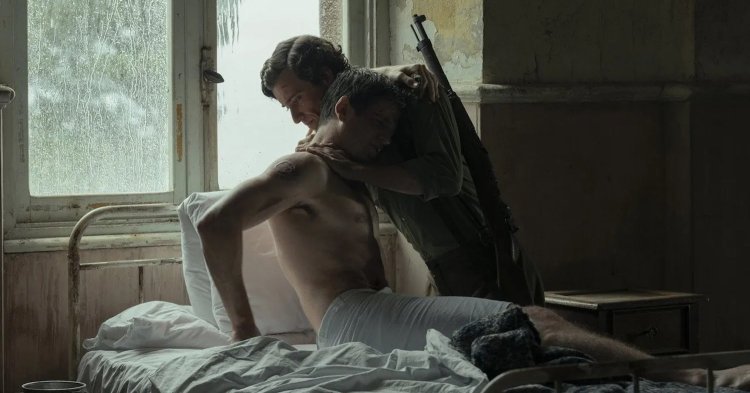
La bola negra has been snatching awards left and right after a breakthrough premiere that has taken viewers from across cinema and film by surprise. The film is set during the Spanish Civil War and modern Spain through the lens of three gay men affected by intertwined struggles. The film takes us to several places and years: Granada, Andalusia, 1931, right before the Spanish Civil War; Comillas, Cantabria, 1936, in the middle of the conflict; and Madrid, 2017.
Across these three scenarios, these three gay men find themselves struggling with external validation in conservative societies, the traumatic weight of war, and generational struggles being passed down. These issues are connected struggles that feed into one another, framed in the wider challenges of a divided Spanish society.
Unlike other European countries with similar episodes in their contemporary history, the Spanish have lacked a proper synthesis or closure for their internal conflicts—continuing to haunt the country to this day. But what has made this film different from others set in this time period and other forms of queer cinema? And why is it becoming famous for making loads of people leave the cinema in tears?
Comillas, 1936
The first scenario introduced is that of Comillas in 1936. Sebastián, (played by Álvaro Lafuente Calvo, known professionally as Guitarricadelafuente), a small-town boy who, after losing his entire family to an air raid, is forced into conscription by the insurgent right, despite not grasping entirely what he is even fighting for. When, during service, he meets Rafael (played by Miguel Bernardeau), a republican lieutenant captured by the fascist rebels, he faces the harsh reality of conflict.
Sebastián had become infatuated with the man he was forced to hold prisoner and, later, execute. He lives through an experience difficult to understand for anyone who, like most viewers, have not lived through full-blown war and the lack of choice and freedom the most vulnerable individuals lose in conflict. His role highlights how, at wartime, it does not matter who you are or what you want to do, but only if you are useful or an inconvenience.
Personal preferences make room for survival, and any new motivation stems from fear. A lot of people involved in the Spanish Civil War had their choices made by where they lived, who they were neighbours with, or what their family believed, especially in a time where most people lacked a political conscience in the same way that we do in today’s digital world.
Granada, 1931
Talking about family struggles, the viewer is also introduced through the story of Carlos (played by Milo Quifes) in the Granada of 1931: a young boy from an aristocratic family who, under pressure from his father, tries to join the city’s casino social club. He gets rejected, or “black balled” (hence the film’s name), which has already become code for every time queer people get rejected from somewhere for simply being queer.
Carlos ends up dying in a bombing in the casino right after begging for a second opportunity and publicly renouncing his sexuality. He literally dies the moment he rejects his identity. It is then revealed to us that, after the Spanish Civil War and during the fascist regime, Sebastián forms a family with a woman and has a daughter, Teresa, but abandons her before she is born after he falls in love with a man.
The pressure of patriarchal expectations leads Sebastián to leave behind his family to live in the countryside with his true love, accepting his queerness but also abandoning Teresa, who would struggle without her father and have the rest of her life shaped through addiction and resentment towards her father. Yet, he lived in an ultraconservative society under a fascist regime that heavily criminalised queer people. This faces us with the question: is he responsible for his daughter’s trauma?
Madrid, 2017
When Alberto (played by Carlos González) seeks help from Isabelle (played by Glenn Close), a historian specialising in Federico García Lorca’s literature, she replies: “You have an inheritance and you don’t know what to do with it. You’re Spanish”. A perfect encapsulation of what it means to be Spanish, especially after the Spanish Civil War and the dictatorship, but also a demonstration of how many problems run across generations.
Spain as a society is just like this. We are the product of a tumultuous history we have not quite got over yet. The Spanish have a very complicated relationship with their contemporary history and their national identity. The current political system is increasingly questioned by both left-wing and right-wing groups outside of the establishment. It is not uncommon to see people talk about a so-called “‘78 regime”, criticising the democratic credentials of the 1978 constitution.
On the left, people have questioned the legitimacy of this framework because it was approved as a result of the Francoist institutions allowing it to happen under an undercover ‘gentlemen’s pact’. On the right, nostalgia and a new wave of romanticisation of the dictatorship, along with a disregard for the democratic system, have resonated with younger generations who are far detached from those who actually lived through it.
Spain, 2026
Multiple studies this year have shown that as many as one-third of Spanish young people would prefer a dictatorship to a democracy. As obvious as it seems, it is worth noting that the rising cost-of-living and the housing crisis have a big impact on this. People are not happy with the cards they have been given, and they are looking for answers. The easiest answer? Blame it on democracy, the only system that tolerates dissent, and the vulnerable and minority groups protected most by it.
While some buy into the aesthetics of war, La bola negra exists to remind us that war and illiberalism are not how you fix a system that is clearly not working. And, in doing so, it invites us to sympathise with one of the most impacted figures by war: gay and queer communities. In wartime, queer people are the first to be stripped of their rights, with all sorts of liberal, democratic boundaries being overstepped if they are deemed to be non-essential.
We now live in a world of niches, where everything comes tailored to ourselves. The media is careful to only show us what we already agree on and what we already like. Algorithms, artificial intelligence, and staying at home have made us recede within ourselves, impacting our critical, reading and social skills. We have developed the worst crisis of all: an empathy crisis.
It is not only about fighting for a fair system, but also about acknowledging and getting to know who is next to us. When Federico says to Rafael, “in this country, there are tons of love stories buried in the ground. We need to dig with our hands to let more come out”, it is not only a reference to the search for mass burials from the Spanish Civil War, which continue to this day. It is also talking about the countless stories that were erased or shadowed by the pretext of war.
The link from 1931 to 2026
In 2017, Rafael’s family does not want to talk to Sebastián’s grandson, Alberto, because they only knew that Sebastián shot him dead, but not that he was forced to do so and forgiven by Rafael himself, who knew that Sebastián would simply join him in a mass grave if he refused. The leitmotif throughout La bola negra is that freedom of choice is what makes us alive. Sebastián could not hold onto a fake life after what he went through, and Carlos died in the casino right after giving up.
In the final moments of the film, Carlos begs “the snow” (a distant voice symbolising the afterlife) to come back to life. He cries that he had not been given the chance to start his life. He realises that until now, he had been living to fulfil other people’s expectations. His whole life now felt like a waste of time. When Lorca shows Carlos’ story, the original La bola negra, to Rafael, he says that it is meant to help others like them in the future. It is a lesson to find meaning in life by living authentically.
But are the oppressed the ones who need to watch the film? When I left the cinema, one of my friends pointed out the sad truth: “the people who need to watch it the most won’t”. I replied: “and if they do, would they even get it?”. While time will tell if we were right, it is still our responsibility to hold on to what we have left: hope and the will to fight for what ours is. We may or may not get out of this, but if we do not try then we will certainly not. For now, let us simply toast to being alive.


Follow the comments: |
|
