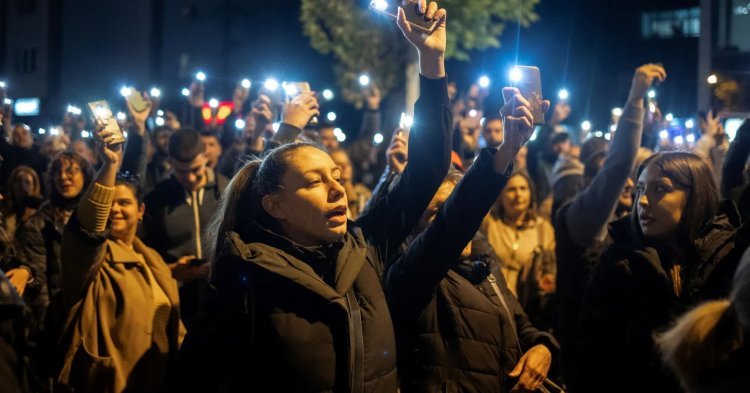
On 25th October, parliamentary elections were held in Serbia. The electoral list backed by the anti-government student movement won 53% of the vote, securing 140 out of 250 seats in the National Assembly, and bringing an end to the 14-year rule of Aleksandar Vučić. In a landmark moment, protests led by students grew from something ordinary into an extraordinary, organised political force, capable of bringing about a shift of power.
It started with a railway canopy collapse, in which 16 people died and a nationwide corruption scandal was triggered. The students subsequently led university blockades and peaceful protests, eventually leading to calls for an election and a place for the students on the ballot. The mystery surrounding these elections for any external observer is: why now? How did a student revolt lead to Vučić losing power? To understand this, you must understand Slobodan Milošević’s legacy.
From Milošević to Vučić
Serbia is no stranger to overthrowing authoritarian, semi-democratic governments. In 2000, Milošević refused to recognise his electoral defeat, triggering the so-called Bulldozer Revolution. Towards the end of his reign, Vučić was appointed Minister of Information, during which time he introduced restrictive measures against journalists and independent television networks. It did not keep Milošević in power, but it did make Vučić skilled at political repression and propaganda.
Vučić left the far-right Serbian Radical Party after Milošević’s fall from power to help establish the more moderate, right-wing populist Serbian Progressive Party (widely known as SNS). Once SNS won power in 2012, Vučić began creating a dominant-party state and appointing his allies to key positions within the apparatus of the state. The media was manipulated in favour of SNS and opposition was labelled as foreign manipulation within Serbian politics.
The eruption of the student protests
Vučić was consistently victorious in elections during his reign, which further helped him tighten his grip on the judiciary and the police force. Towards the end of his reign, he would occasionally deploy masked civilians to intimidate opponents, who would then be pardoned or acquitted. But after the railway canopy collapsed in 2024, the student protests erupted, eventually causing full university blockades.
The government was quick to label the students as simply attending the protests to skip class and cause chaos. But the students made a decisive choice: to keep the protests entirely peaceful, to remain independent of existing political parties, and to operate without a single leader, instead voting on every decision and effectively turning the institutions they formed into direct democracies.
The strategy of the student movement helped protect them from the same kind of media attacks Vučić had traditionally employed, while further increasing their popularity. Rallies were organised, along with student activists running, cycling, and walking across the country to spread their message. This catapulted the student movement from university campuses into a nationwide organisation, with students as its public face and representatives.
What was different about this election?
The student movement started with demands for certain reforms, but soon realised this was insufficient, so elections became their primary goal. After almost two years of protests, Vučić announced parliamentary elections. This was officially about timing for Vučić, as his public stance was that he would not meet the students’ demands. Nevertheless, the student movement organised and stood for election independently of the traditional opposition parties.
Instead, professionals and academics were chosen for the Student List. An almost referendum-like atmosphere was achieved. The election arrived with an unusually high turnout just short of 70%, ending with Vučić recognising the success of the students and peacefully surrendering power. Yet, even though his reign did not end violently, Vučić is still running a campaign against the new parliamentary majority with false claims that the country is descending into chaos and disorder.
Vučić maintained close ties with leaders such as Viktor Orbán, himself rejected by Hungary’s voters earlier this year, and Vladimir Putin, who provided him with political support beyond Serbia’s borders. The railway canopy collapse was linked to the Hungarian state, raising questions about its involvement and the circumstances surrounding the collapse. Orbán’s fall took away some of his protection and showed he could be next. It was no longer unfeasible for an authoritarian to be removed from power.
Serbia’s relationship with Europe
Even though Vučić and his party are officially in favour of EU membership and a constructive relationship with its European partners, it is not rare for them to portray the EU as an unwelcome source of foreign intervention. Vučić is very intentional in not choosing a side, instead promoting his “balance game” between East and West. Other student and youth protests in Europe, although increasingly widespread, hold major differences to the ones in Serbia.
The goals of the protests vary widely depending on where they are held. The main difference between those in Serbia and the rest of Europe is their “no-ideology policy” and disassociation from mainstream politics. One student I spoke to said “they genuinely felt like a breath of fresh air from the polluted and corrupted politics we are used to”. Serbia’s example demonstrates how effective organisation can lead to remarkable political change.
Although Serbia does have a history of revolution, Vučić’s defeat in these elections was not predicted externally. Numerous factors played a part in the change of government, some of which were merely based on circumstances. Student and youth organisations continue to grow around the world, but Serbia’s experience should not be seen as a universal template. The future is still yet to show what kind of beginning this end has marked.


Follow the comments: |
