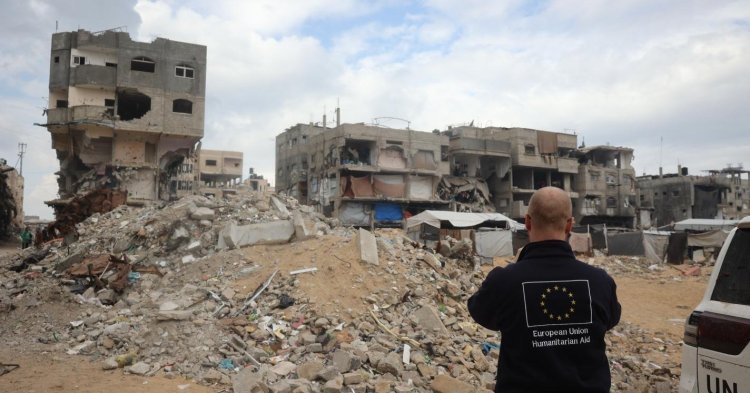
The EU is the largest provider of aid to the Palestinian Authority. It passed a €1.6 billion support package for 2025–2027, while simultaneously remaining one of Israel’s biggest economic partners. Yet, this economic power has not translated into political leverage. Since the 1970s, the EU (and formerly the EC) has attempted to play an independent, diplomatic role in the region, but it has been consistently and intentionally constrained in doing so.
Firstly, the deliberate marginalisation by the US and Israel has systematically excluded the EU from political negotiations while accepting its financial contributions. Secondly, the EU’s own institutional structure: internal fragmentation, the unanimity rule, and a persistent gap between the rhetoric of strong declarations and its operational power through sanctions and coercive diplomacy, has left it unable to respond. But how did the EU’s position as a “payer” but not a player emerge?
The origins of Europe’s “payer” role
The first significant involvement of the EC in the region followed the 1973 war between Egypt and Israel. The Brussels Declaration called for Israel’s withdrawal from the territories it had occupied after the Six-Day War, and it aimed to establish a European role in the peace process. Washington and Israel interpreted this as a pro-Arab stance, which opened an opportunity for Euro-Arab dialogue and positioned the EC as a potential mediator.
The Venice Declaration of 1980 went further. It recognised the Palestinian people’s right to self-determination and acknowledged the Palestine Liberation Organisation as a legitimate political actor. This position contrasted even more sharply with that of the US and Israel. However, this did not produce the intended outcome of a greater European role. The US, investing in the Camp David framework, viewed European involvement as a disruption, while Israel opposed it outright.
The EC was effectively excluded from negotiations throughout the 1980s. The Madrid Peace Conference in 1991 marked a turning point, but not in the EC’s favour. It was only granted observer status, and instead assigned leadership of the Regional Economic Development Working Group, supposedly tasked with demonstrating the benefits of economic cooperation. This role was not an accident. Both the US and Israel recognised Europe’s financial capacity and wished to limit its involvement strictly within the economic sphere.
The EU assumed the EC’s role of a financial supporter, effectively accepting its own diplomatic marginalisation. The Oslo Accords of 1993 reinforced this trajectory. It became the primary financier of the Palestinian Authority and took a leading role in economic coordination. While this support was crucial to sustaining administrative structures, it also deepened the EU’s confinement to a financial role. This dynamic was convenient for other actors: it reduced their financial burden while keeping the EU away from political decision-making.
How the EU undermines its own influence
The EU’s influence peaked in the early 2000s. Following the outbreak of the Intifada, the EU joined the Quartet alongside the US, the UN, and Russia. For a moment, it appeared to have secured a seat at the table. Yet, this inclusion did not translate into real influence. The US retained agenda-setting power, Israel remained sceptical of the EU’s intentions, and the EU itself was internally divided. As a result, Europe continued to fund initiatives without shaping them.
External exclusion explains only part of the problem. The EU’s marginalisation is also self-inflicted. Internal fragmentation remains a decisive obstacle. With 27 member states, each pursuing its own priorities, achieving a coherent foreign policy is inherently difficult. Even when it had fewer members as the EC, coordination was challenging. Today, the difficulty is structural. Under the Common Foreign and Security Policy, unanimity is required. This ensures that any single member state can block decisions, leading to chronic paralysis.
One government can veto sanctions, another can oppose a joint statement, while others pursue their own independent, bilateral policies. Israel’s military campaign in Gaza following Hamas’s attack in October 2023 exposed these divisions clearly. While the EU called for humanitarian pauses, a two-state solution, and eventually a ceasefire to this aim, individual member states adopted divergent positions. This is not merely political disagreement, it is an institutional limitation.
The creation of the High Representative for Foreign Affairs was intended to unify Europe’s voice, but in practice, it has multiplied representation and added complexity. In response to the crisis, the EU reverted to familiar patterns: increased humanitarian aid, support for UNRWA, and vague calls for the violence to end. However, on decisive issues, such as leveraging trade agreements, imposing sanctions, or immediate recognition of Palestinian statehood, the EU remained inactive due to its internal disagreement.
This pattern extends beyond crisis management. The EU formally supports a two-state solution, yet its policies often do very little to support this objective. Continued heavy economic partnership with Israel, despite ceasefire violations in Gaza and settlement expansion in the West Bank, illustrates the gap between principle and practice. The result is a persistent paradox: the EU possesses the resources and normative framework to act, but lacks the institutional cohesion and political will to translate them into influence.
From an economic actor to a political actor
Despite these limitations, the EU retains the potential to redefine its role. Gaza represents not only a humanitarian catastrophe but a strategic disaster. Instability directly affects European security through migration pressures, increased terrorist activity, and weakened Arab relations. The EU must start by aligning its economic instruments with its political objectives and its trade agreements and financial assistance should be conditioned on compliance with international law. Without such conditionality, economic power cannot become political leverage.
Institutional reform is more essential now than it ever had been. Moving from unanimity to qualified majority voting in foreign policy would reduce paralysis and enable more consistent action. The EU must reduce its reliance on the US as the primary diplomatic actor. While transatlantic cooperation continues to hold merit, European interests and values require greater independence.
This means building partnerships with regional actors such as the Gulf states, Turkey, and Egypt, and strengthening its own diplomatic initiatives on the ground. None of this will be simple or easy. Yet, the alternative is clear: to remain what the EU has been for decades—a financial contributor without political influence. The EU has the capacity to shape outcomes in other parts of the world. The question is whether it is willing to move beyond its role as a payer and finally become a player in world affairs.

Follow the comments: |
