The 19th September marked the three-year anniversary of the bombardment of the Armenian population in Artsakh (known internationally as Nagorno-Karabakh). For over 2,000 years, their descendants had been living in the region. And now all signs of Armenian life have been erased. For me, this was not just an isolated event in another corner of the world. In March 2023, I moved to Yerevan to work for a humanitarian aid organisation—a random decision that changed my life.
I moved with little knowledge of a country that very quickly felt like home. I had vaguely heard about the Armenian Genocide by the Ottoman Empire and snippets of the Second Nagorno-Karabakh War had made it into the Danish news in 2020. Armenia was still largely unknown to me and I had no idea what to expect. I was 20 years old, and I had a strong appetite for life.
The first person I met in Armenia was a girl from Artsakh. She proudly told me about her home, the beautiful landscapes, the mountains, the traditions of Artsakh, and the churches that had been there since the 4th century. Then she turned serious. At that time, she wasn’t able to get back to Artsakh. She never got to go back. She never got to say goodbye to the land she grew up in. The land her ancestors came from. The land she called home.
The day that everything changed
I remember the 19th September like it was yesterday. I had been at work the whole day and I was waiting for the bus when I saw the news. The first thing I saw was videos of the bombings. It took me one hour to get home and I was updating my news feed religiously for more information. In the following days, Yerevan was filled with protests and journalists.
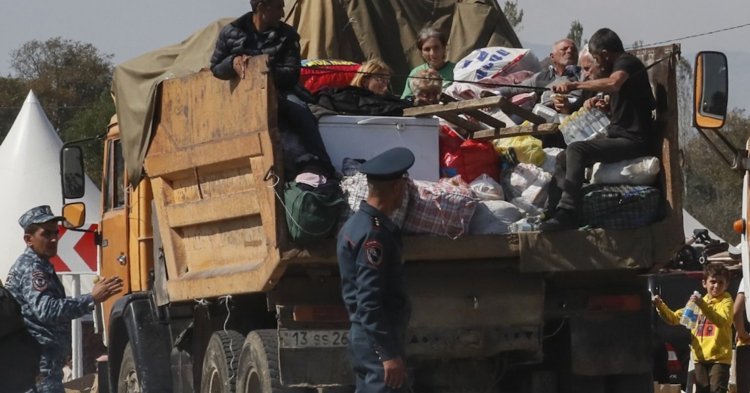
On Instagram, you could see footage of the cars leaving Artsakh for Armenia. In total, over 120,000 people were forcibly displaced. Kornidzor, the nearest village to Artsakh, was flooded with people who had no idea what to do now. Because what do you do when you lose your home, your livelihood, your everything, from one day to the next?
From March until September, I had been working with vulnerable people and people living in poverty all across the country. Suddenly, I was also working with forcibly displaced people. We handed out humanitarian aid packages to them and I visited refugee camps, organised activities for the children, and documented the life stories of Artsakh families. To understand the story of Artsakh, you have to understand its history.
The history of Artsakh’s struggle
Artsakh, or Nagorno-Karabakh, is a region located within the territory of modern-day Azerbaijan. For centuries, the region was inhabited by an Armenian majority. Christians churches and monasteries serve as living proof that Armenian life has always been present in the region. But, in 1921, the Soviet Union decided to place Nagorno-Karabakh under Azerbaijani rule.
The relationship between the Armenian majority and their Azerbaijani authorities was mostly peaceful throughout the duration of the Soviet Union. But after its dissolution, the First Nagorno-Karabakh War broke out between the newly-independent states of Armenia and Azerbaijan. They fought over who would gain power over the territory. During the Armenian Genocide, it had already lost a large amount of its land to Turkey. It was unwilling to allow Artsakh to be taken too.
In 1994, Armenia won the war. The Republic of Artsakh was proclaimed and acted as an Armenian self-governing state. But the international community continued to recognise it as a part of Azerbaijan, even though Armenia had won the war and the vast majority of the people living there were Armenian. They had made clear their wish to be self-governing, but their right to self-determination was not respected by the international community.
For almost 30 years after the war, the Republic of Artsakh existed, inhabited by Armenians, supported by Armenia, but with its own government, currency, flag, dialect, and education system. Artsakh was connected to Armenia through the Lachin corridor, the only road between Armenia and Artsakh. The people had Armenian passports with a special country code expressing that they were from Artsakh.
Azerbaijan attempted to take over Nagorno-Karabakh several times. This resulted in several casualties and eventually the Second Nagorno-Karabakh War in 2020. Supported by Israel who supplied them with weapons and Turkey who provided Syrian mercenaries to fight for them, Armenia was forced to surrender after 44 days and laid down their arms. They never had a chance of survival.
The humanitarian blockade and what followed
Some of my friends fought in that war. They are just a few years older than me. One of them even still has a permanent injury from the war. Another told me that he was the only one from his unit who survived. They were just 19 and 20 years old when they had to defend their homeland. After the war, Azerbaijan took control over several villages of Nagorno-Karabakh. Other villages resisted and remained Armenian.
In December 2022, Azerbaijan blocked the Lachin corridor. This meant that food supplies, humanitarian aid, medicine, and gas were not able to enter into Artsakh. People were starving. The road to civilization was closed. I remember one mother telling me how she had to give birth to her baby without any painkillers, because there simply were not any painkillers left.
They did not let anyone in and they most definitely did not let anyone out. This is the reason why my dear friend, who I met on my first day in Armenia, was never able to come home. The blockade went on for 10 months. Then, on the 19th September 2023 the bombings started. Everyone fled because no one wanted to be left alone with the enemy. On the first day of 2024, the Republic of Artsakh was dissolved.
For the last three years, Artsakh and what is left has been completely in the hands of Azerbaijan. I talked to a lot of people from Artsakh. I always sensed that they were proud to be from there. My friend told me that she will speak to her children in the Artsakh dialect to keep it alive. A part of me wishes that I had arrived in Armenia early enough to visit the land that means so much to so many of the people I met. The land that they fought so hard to keep. The land that they love so passionately.


Follow the comments: |
