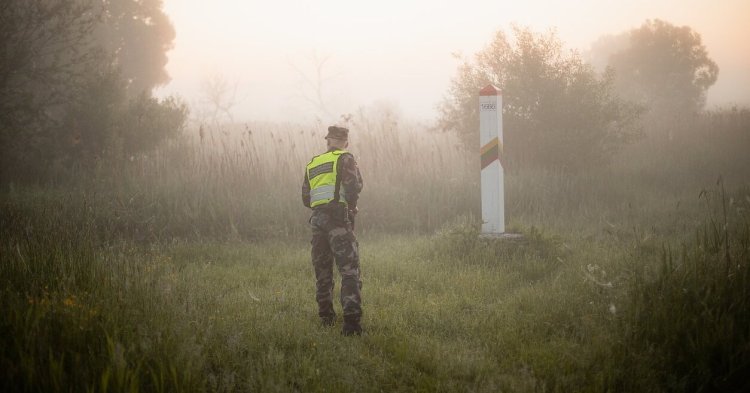
The migration crisis between Morocco and the Spanish enclave of Ceuta has largely concluded as quickly as it emerged. Its lasting effects on the EU’s internal and external discourse on migration are already being widely discussed. Yet, this discussion often ignores that there has been a migration crisis unfolding for more than five years involving hundreds of thousands of people. And this one is not confined to an enclave—it covers the entire 1,250 kilometre EU-Belarus border.
Lukashenka’s regime in Belarus orchestrated the crisis as a retaliation tactic against the EU for its support of the democratic protests unfolding in 2020 and its sanctions on individuals and organisations involved in the regime’s subsequent suppression and extreme violence against protestors. Lukashenka, with the help of the Russian secret service, attracted tens of thousands of both genuine asylum-seekers and economic migrants from the Middle East and North Africa.
In many cases, people were lured by false advertising, propagandist tour agencies, and even channelled through human-trafficking networks. After being transported to the forests and swamps of the EU-Belarus border, these people were left stranded and with no other choice than to illegally cross the border after Lukashenka’s soldiers confiscated their documents.
Of course, this was not the first time migration flows had been used as a weapon; similar tactics were previously used by authoritarian regimes in Libya, Cuba, and Turkey. But the EU-Belarus crisis is unique because it was the largest artificial border crisis in Europe in decades prior to Ceuta, and unlike Ceuta it targeted several countries simultaneously. Understanding the continued threat that weaponisation of migration holds is of vital importance for Europe’s geopolitics.
The EU-Belarus migration crisis has not stopped
As the crisis is used as a pressure tool against the EU, all three EU member states bordering Belarus (Poland, Lithuania, and Latvia) are targeted. Since 2021, an estimated 210,000 crossing attempts have been recorded, with Poland alone accounting for 137,000 of them. While the absolute peak of 2021-2022 has passed in terms of numbers, the border remains a constant pressure point to this day, with around 10,000 further crossing attempts in the first months of 2026 alone.
Yet, if we look at the migratory trends, we can see that the channelling to different destinations, as well as the intensity of the pushes, serves the regime’s interests at any given moment. As a sign of goodwill to the Trump administration during negotiations over political prisoners, both Poland and Lithuania have seen a sharp decline in border activity. Latvia, increasingly seen by the Russian regime as the most hostile of the Baltic states, is experiencing its highest numbers to date.
One of the most unfortunate aspects of this crisis is the deterioration of human rights standards among the member states involved, and the overall humanitarian catastrophe in the border regions. Faced with daily attempts at physical border breaches, Poland, Lithuania, and Latvia underwent a rapid securitisation at both the infrastructural and legislative levels.
Pushbacks of people—and their human rights
The scale and intensity of the pressure, especially during the 2021-2022 peak, resulted in hundreds of documented cases of unauthorised violence, torture, unlawful detention, and other ill-treatment of migrants by the member states’ border security forces. Even more violent treatment is recorded on the Belarusian side, where Lukashenka’s security forces have carte blanche for any level of cruelty.
Both Belarus and EU member states’ border security forces heavily abuse what is called the “pushback” mechanism—or in plain English, physically forcing a person out of the country and back into the neutral zone on the border. Human rights organisations and special monitoring groups assess that no fewer than 20,000 “pushbacks” have occurred since 2021, with some people caught in an endless cycle of being pushed between the two sides.
According to the same monitoring groups, at least 107 deaths have occurred in what they have called the “death zone” between the two borders, where the most vulnerable people have been left without any support and stripped of their most basic human dignity and the resources needed to live—and unable to fight back against their dehumanisation.
Many leading human rights organisations describe the “pushback” mechanism as inhumane and unlawful, which is even more concerning given the fact that all three EU countries have already enshrined it into law. As a result, activists and human rights observers are actively being detained for providing help to the migrants. Monitoring groups also point out the deteriorating transparency and reporting from the border authorities, so the numbers may be far greater than published.
What is the solution to the EU’s border security?
Even before the migration crisis in Ceuta, the EU-Belarus border crisis was overshadowed by more threatening crises such as Russia’s invasion of Ukraine, Israel’s military campaign in Gaza, and the subsequent US-Israel war on Iran. But the real answer as to why the topic was silently dropped and affected member states were left alone is not distraction, but the systematic failures and absence of leadership from the EU on border politics.
The EU’s system of shared competencies has resulted in the usual consequences: free-riding, lack of accountability, and distrust between member states. While every other member of the Schengen Area is insulated from the migration crisis because of the actions of Poland, Lithuania, and Latvia, the failure of the European Commission to provide logistical support and meaningful financial backing means that they are going to more extreme lengths to contain the crisis.
Since external border controls are left to the member states, any attempt at systemically implementing a new approach faces the challenge of navigating different legal frameworks in each country. In turn, this kills the effectiveness of any such system. Meanwhile, a lack of any real cooperation between national and supranational agencies kills transparency and accurate reporting. And, ultimately, any real accountability becomes impossible—at a huge human cost.
As the migration crises on the EU-Belarus border and in Ceuta both showcase, the current system fails to create any sense of solidarity between member states. It is no surprise that they are increasingly eager to jump at any opportunity to impose temporary border checks or call for expelling members from the Schengen Area altogether. The only sustainable, long-term solution to migration crises is a system where there is one strong EU border—not 27 vulnerable ones.


Follow the comments: |
