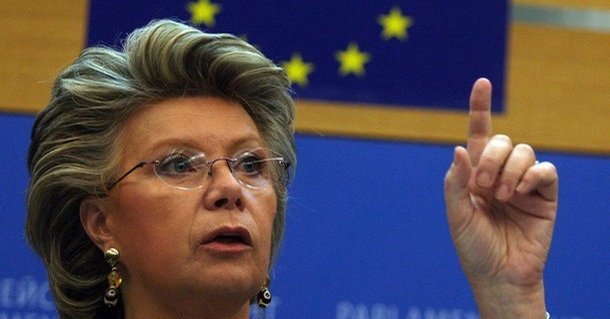
In September 2010, the European Commission took up its new Strategy for Equality between Women and Men (2010-2015), announcing that it was considering using targeted initiatives to get more women into top jobs in decision-making. On 1 march 2011, Viviane Reading, Vice President of the European Commission and EU Commissioner for Justice, Fundamental Rights and Citizenship, launched the Women on the Board Pledge for Europe, asking publicly listed companies in Europe to sign a voluntary commitment to increase women’s presence on their corporate boards by 2020.
The proposal was met with enthusiasm by many ministers from Member States, who then proceeded to support and encourage national listed companies to make more efforts to increase women’s representation on their boards by signing the Pledge. In addition, both the European Parliament and the European Economic and Social Committee welcomed the Pledge. In 2011, France, the Netherlands, Italy and Belgium put into practice legislative measures in order to improve gender balance in company boards. According to figures from the European Commission’s Report on Equality between Women and Men 2010, women make up about 60% of the employment workforce across the European Union but the same level of representation does not exist in senior positions.
Diversity in the workplace, at all levels, needs to be on display more in European nations in order to strengthen Europe’s competitiveness and successfully battle the present economic crisis. From legislation to application on a voluntary basis, quotas intend to establish a fixed percentage or number for representation of a specific category of persons. Somewhere about half of the countries in the world already put to use gender quotas in politics. Some are written into the constitution, some are legislated quotas, while others are voluntary.
Reding is interested in following Norway’s example and imposing a 40% quota for women on boards since 2003. The plan was postponed on October 23 and the proposals will now be debated until November. Vince Cable, the British Business Secretary, is leading a campaign against the quota proposals, along with ministers from eight further countries, including The Netherlands, Malta, the Czech Republic, Latvia and Bulgaria.
There should be fair representation in boardrooms in Europe, and companies should do more like introducing transparent selection criteria to give more consideration to women, but imposing sanctions on company and organizations that choose to not comply with such measures will hit companies who believe in equality as well as diversity, hard. Every company or organization does not operate in the same manner and making it unlawful to not impose a strict quota percentage for women on its boards is greatly restricting its capacity and freedom to hire the best talent, because the motive here is to hire the best talent not the best gender-directive talent.

1. On 3 November 2012 at 02:28, by Andy Replying to: Should there be Quotas for Women in Boardrooms across Europe ?
I don’t agree with these quotas. How is it equality between women and men when women get positions because of some quota instead of their actual worth ? What exactly is it that we even still need these discussions for anyway ? Is there any way in which women today are still discriminated against ? Women get more state benefits than men, more leniency in front of the law, more dedicated organizations to help them with various problems and push them through higher education (do any of these even exist at all for men ? ). How is it even possible for such topics to still exist today in a (western) society where being a woman is better in every way than being a man ?
2. On 5 November 2012 at 21:37, by Joe Replying to: Should there be Quotas for Women in Boardrooms across Europe ?
How a Federalist of any kind can hold these views without FIRST noting that you can only have such a view by giving unlimited powers to the state over private affairs is simply blinding.
3. On 16 November 2012 at 02:39, by Osmi Anannya Replying to: Should there be Quotas for Women in Boardrooms across Europe ?
Quotas are an unfair way to target the most talented and able women and bring them into the workforce. Not only do they undermine the “equal treatment on all grounds criteria”, they also get in the way of hiring the best person for a specific role, irrespective of what their gender is. It’s a shame that the European Commission is still pushing for it. This is not the right way to increase uptake of women in European boardrooms.
Follow the comments: |
|
