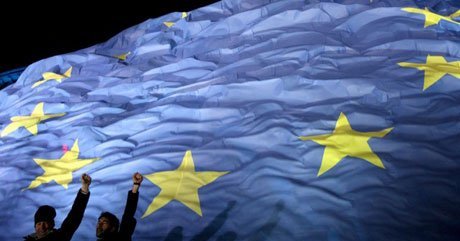
And what about the national flags that are exhibited during the hymns and displayed on the athlete’s clothes? Why not a European flag too?
Those two ideas are raised every time the Olympic Games start. It was the case during the 2008 Beijing Olympics and this year’s London Olympics that many websites were boosting the EU at the top of the medal ranking, as if it were providing an unrelenting argument in favour of the adhesion to a European project (http://www.medaltracker.eu/). {{}} The legal drawback
The Olympic Games are ruled by the Olympic Charter, which encompasses most of the dimensions of the event: the opening ceremony, advertisement, the role of different stakeholders etc.
Political propaganda is clearly mentioned: “No kind of demonstration or political, religious or racial propaganda is permitted in any Olympic sites, venues or other areas”.
The rules of advertisement or propaganda on articles or equipment are precisely defined: “No form of publicity or propaganda, commercial or otherwise, may appear on persons, on sportwear, accessories or, more generally, any article of clothing or equipment…”.
Not respecting such rules would have dramatic consequences for the athletes: “Any violation of the provisions of the present clause may result in disqualification or withdrawal of the accreditation of the person concerned.”
Given the legal framework to abide by, showing a European symbol appears difficult unless the EU is providing the athletes equipment thus becoming a kind of sponsor.
Is the medal count accurate?
Pooling together all the European medals to compare them with other countries, entails a comparison between a more European athletes than China for example. Therefore, whatever the level of the athletes, the likelihood of medals for the EU is statistically higher. Such comparison will contain a bias. Nevertheless the current situation which classifies the countries based on gold medals first and not the total amount of medals is another existing bias.
Counting the European medals won’t provide more accurate results than today, it will only supersede a population-size bias by another one.
What can we learn from it?
Even though a ranking including the EU is not perfect, the results are striking. Namely, the EU is overwhelming the competition if medals were counted altogether. Should we conclude that the EU is more efficient than other countries, as the medal table shows? It sounds at odds with reality.
In my view, it shows more the power of having different cultures entailing a real diversity. The attractiveness to a specific sport is uneven from one European country to another. For example, France is more oriented towards Judo and swimming, the UK more on rowing and sailing. The power of the EU in such competition stands in its capability to find among all European countries a diversity of interest that subsequently results in various sport successes.
Human rights and political message
The Olympics are based on core values underpinned by human rights as recalled in the fundamental principles of the charter: “The practice of sport is a human right”.
The EU project could be associated to some of the objectives explicitly mentioned in the charter: “The goal of Olympism is to place sport at the service of the harmonious development of humankind, with a view to promoting a peaceful society concerned with the preservation of humankind.”
This is not so different from the founding fathers’ objectives.
The supremacy of sport explains the functioning of the Olympic Games. It mainly lies in a clear separation between sport and any other attempt to fulfil the fundamental principles of Olympism. Accordingly, political attempts such as the construction of a federal Europe, aimed at fulfilling the same values as Olympism, have to be put aside during the games.
Federalism
The main conclusion we can draw from the sum of medals is that replacing the national medals with the European ones would undoubtedly be a mistake. We would mainly neglect the diversity of European countries in their strengths and weakenesses towards particular sports.
On the contrary, associating the European flag or calculating European medals alongside the national ones is an attempt to raise a pro-European feeling without dwarfing the national dimension of such success.
A last argument backing the possible use of a double system: federalism is also about efficiency and we can’t sideline the simple question: “Is the sport policy more efficient when implemented at the European level?”
Personally, I am not convinced.


1. On 13 August 2012 at 18:50, by Charles Replying to: Should we count European medals at the Olympic Games?
Europe is not a country and it makes no sense to total the EU individual state medals in an attempt to be the “winner”. We can cooperate, be friends to some extent, and accept that geographically our fates are more closely interlinked than we might like, but the perverse desire to be a federal union is neither wanted nor realistic.
2. On 16 August 2012 at 20:09, by Andy Replying to: Should we count European medals at the Olympic Games?
I doubt everybody shares your, rather outdated, view, Charles. I still can’t understand why some people are so fixated on separating themselves from those around them by any means necessary. A united Europe is an idea that has been set in people’s minds, and it will not go away, no matter what people that would rather cling to some odd sense of “nationalism” would like to think.
3. On 9 September 2012 at 10:04, by Hoover Replying to: Should we count European medals at the Olympic Games?
I share Charles’s view, and don’t regard it as outdated or odd.
I’d also like to address your puzzlement as to “why some people are so fixated on separating themselves from those around them by any means necessary”.
Firstly, that view is something of a straw man. It’s not really a “fixation”, and the separation doesn’t really happen “by any means necessary”.
Secondly, some of us regard the centralisation required by federalism as inherently harmful. It can bring efficiency as the article suggests, but on balance we think the disadvantages outweigh the benefits.
The chief disadvantage is the loss of accountability and hence of democracy. The closer the executive is to the people, both literally and metaphorically, the better we’re able to scrutinise its actions and ensure that it behaves justly and sensibly. If our politicians stay within range, they’re also more likely to grasp and respond to the problems that really concern us, rather than working on imagined problems that don’t really affect anyone. In our eyes, it’s absurd that an MEP for Dubrovnik should be formulating legislation that will affect people in Tallinn.
We also find troubling the desire to create a “pro-European feeling” as described in the article. There doesn’t seem any practical necessity for such a feeling, so it’s difficult to understand why any effort should be made to create one. It wouldn’t increase wealth, it wouldn’t reduce inequality, it wouldn’t make trains run faster, and I can’t imagine it making anybody happier. It’s not pro-European feelings that are likely to prevent war, it’s the excellent work the EU has done to reduce trade barriers.
I hope that makes our (or at least my) position a little more understandable.
Follow the comments: |
