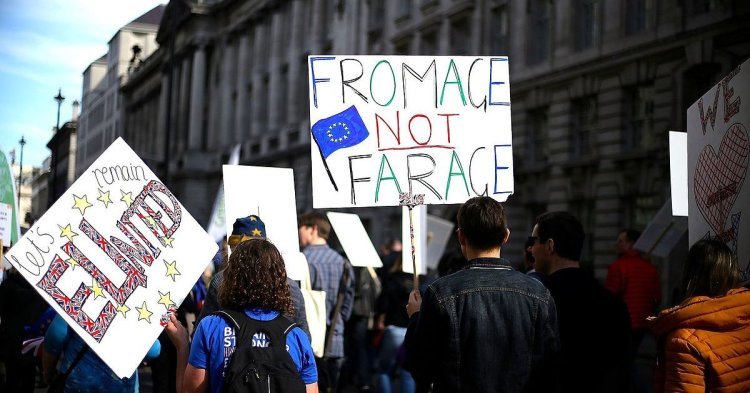
The October European Council meeting in two weeks was originally supposed to be when the Brexit deal is finally clear. The remaining few months would then be spent on voting the deal through the European, UK and other national parliaments. Instead, the UK government’s intransigent, repeated and futile attempts to bend EU rules in its favour have brought us to a point when we still have no deal. According to reports, the last-gasp attempt at a deal will be a modified version of the “backstop” proposal that would see a special regulatory regime for Northern Ireland on areas like food, and which would entail checks for goods moving between Northern Ireland and the rest of the UK. However, Northern Ireland’s Democratic Unionist Party, who provide crucial support to the Conservative minority government, have vowed to reject this last-minute proposal.
In other words, the UK government is still facing some of the same issues as always before: what works for London is against EU rules, and when it isn’t, it doesn’t work for the DUP. The hard right of the Conservatives remains critical of the government’s negotiating strategy, with Boris Johnson calling on Theresa May to “chuck Chequers” in his party conference speech. [1] In these circumstances, we can’t dismiss a “no-deal” option, or the conclusion of a deal that the UK Parliament will reject. In either of the two cases, the UK may well just stay in the EU instead.
Pressure from moderate Conservatives and Labour
Even though “no deal is better than a bad deal” is one of the innumerable Brexit phrases repeated in the media, there is no parliamentary majority for a no-deal Brexit. As a result of a major parliamentary showdown in June, started by moderate Conservatives demanding Brexit safeguards, the government must submit a motion to the Parliament on its next steps on 21 January in the event that there’s no deal by then. Much debate will likely ensue on what legal power the MPs’ voice has in that situation, but it is difficult to imagine the parliamentarians to allow a no-deal exit, especially as the government is woefully unprepared for such an outcome. In the no-deal scenario, intense and detailed constitutional debates will lie ahead, but many optimistic pro-Europeans in the UK assume that thanks to the “January 21” provision, a no-deal Brexit is dead.
What if there is a deal, but the UK Parliament rejects it? At the Labour Party conference, the tone of party leader Jeremy Corbyn’s speech suggested that the party would vote against the Brexit deal that Theresa May is looking after. This was not to be taken for granted: over the past months, there has been much speculation about whether the Labour Party would vote against the deal, or give Theresa May an easy pass by abstaining in the crucial vote on the deal.
In the event that the deal is rejected, the Labour Party leadership would in the first instance prefer to see a general election, but a motion that gives Labour a mandate to campaign for a new referendum was also accepted at the party conference. Shadow Chancellor John McDonnell scandalously said that such a referendum would not include an option to remain in the EU, but the party’s Brexit spokesperson Keir Starmer stated that “nobody is ruling out Remain as an option”. Even though there remains unclarity in the Labour Party’s Brexit position, it is today much more welcoming of a fresh Brexit referendum, and of staying in the EU, than what it was before the conference. Jeremy Corbyn no longer rejects the idea of a new referendum.
May’s parliamentary trouble intensifies
All in all, as March 29 is getting closer, it is harder for Theresa May to push the UK out of the EU without a deal, and it’s harder for her to get a Brexit deal voted through the Parliament. In the event that the Brexit deal is rejected by the Parliament, it’s now more likely that the outcome will be a new referendum. And in the event that there is a new referendum, it’s now more likely that the option to stay in the EU will be available.
Theresa May still hasn’t got her deal through the Parliament. She doesn’t even have the deal. In other words, she hasn’t achieved anything yet. As the time is running out, it’s becoming less and less likely that she can come up with something that satisfies the MPs. At the same time, in the world of alternatives and counterfactuals, Remain is gaining currency. As March 29 is approaching, Brexit is getting less likely, not more.








1. On 6 October 2018 at 12:07, by Reginald Bowler Replying to: March 29 is fast approaching. That means Brexit is getting less likely, not more
“Theresa May still hasn’t got her deal through the Parliament. She doesn’t even have the deal.”
The first thing is because of the second.
Negotiatoins are still ongoing. Don’t you look in the press, on TV or online?
As for “Brexit is getting less likely”, you wish. We’re out, and you would not want to keep us in.
2. On 6 October 2018 at 19:26, by Ian Beckett Replying to: March 29 is fast approaching. That means Brexit is getting less likely, not more
This site has refused to believe that a referendum would be held, then that we would vote to leave and now that we will actually leave. Assume for a minute despite public outrage a new referendum was held (and that is the only way the 2016 result could be reversed). The EU would need to decide under what conditions the UK would remain, as we were in 2015, as was renegotiated in 2016 or something else. Certainly Remain could never win any contest that required the UK to join the euro, join Schengen, lose its rebate or any of the other exemptions we had. But despite that let’s consider what would happen if Remain did win. The polls still show the result could go either way, a Remain win by 52% to 48% certainly would not resolve the matter. You would have a UK as a member that would face ferocious anger and resistance at home regarding any extension of the EU in terms of politics (so all plans for further integration are over, unless yet more exemptions are granted) Result, paralysis. The reality you have to accept is that the genie is out of the bottle and it is better for both sides that fruitless attempts to stuff it back in are abandoned and instead a new reasonable arrangement is reached simply on trade. The UK never had the emotional attachment to the EU that is found on the continent and for that reason alone Brexit is inevitable.
3. On 12 January 2019 at 04:51, by Hugo Replying to: March 29 is fast approaching. That means Brexit is getting less likely, not more
This is where your argument fails: The European Union (Withdrawal) Act 2018 is law. Bar a further Act of Parliament, the UK is leaving the EU at 23 hours on 29th March 2019 - with or without a deal. That is the default position.
Follow the comments: |
|
